Showing posts with label United States. Show all posts

29 June 2008

About Time

Just as President Bush is moving to have North Korea removed from the list of nations that support terrorism, Congress is working to remove Nelson Mandela and the African National Congress from the terror watch list.

Mandela's ANC party has been on the list for longer than I've been alive, being put on it during the Reagan administration, a decade before apartheid officially ended.

I can think of no reason that the US ever should have labeled the ANC, militant though it was, as a terrorist organization at the same time we were supporting the Iraqi Ba'ath regime and the Mujahideen in Afghanistan.

Just something to think about.

Rock on.

26 June 2008

Somebody Please Tell Me...

...why we're leveling sanctions against Iran as we lift sanctions against North Korea.

Yes, Iran has nuclear ambitions. Yes, Iran sponsors terrorist groups. No, Iran is not our ally.

But North Korea claims to have detonated nuclear weapons. The Kim regime has been engaged in a reign of terror since it took power. And North Korea is still at war with one of our allies.

I know, I know - North Korea is taking great steps towards ending its nuclear program. Just like they've done in the past.

Don't get me wrong. I'm glad North Korea is dismantling its nuclear program. But should a regime that has kidnapped and murdered people, both in North Korea and elsewhere, really be taken off of the terrorism blacklist?

Rock on.


21 April 2008

Chinese Olympic Demands

A Facebook group, Chinese United Against Western Media Bias!!!, has made the following demands of the Western media:
Our Demands:
1) We demand fair representation!
2) We demand a stop to slander, insults, and racism!
3) We demand a peaceful, non-politicized Olympics!
4) We demand that our respective nations embrace China as a friend and NOT as an enemy!
In response, I issue the following demands of the Chinese government. In order for me to even consider supporting the Beijing Olympic games, these must be met.
1) I demand that the Chinese government allow for the free flow of information to all their people, and that their people be given the right to self-expression.
2) I demand that the Chinese government stop slandering the Tibetan exiles. The Dalai Lama is a respected religious and political figure and should be treated as such.
3) I demand a peaceful dialog between the Chinese government and their opponents.
4) I demand that the Chinese government embrace its citizens as human beings, not enemies.

As for the members of this group, I make the following requests from them.
1) I respect your desire for fair representation, but know that China is guilty of human rights abuses and persecution. I ask that you open yourself up to hear all sides of the story.
2) If you have been offended by comments, I apologize, but please realize that opposing the Chinese government does not qualify as racism unless it is based solely on the fact that they are Chinese.
Reporting the misdeeds of the Chinese government does not qualify slander unless the stories are untrue.
3) Please note that while the Olympics are supposed to be non-political, the politicization of the games is inevitable.
4) Please realize that you cannot demand a country to be a friend. Remember the maxim, "What's the best way to turn an enemy into something else? Treat him as a friend."

Those who agree with me on the subject of the games, I ask that you keep the following in mind:
1) We should not demonize the Chinese people for the actions of their government. They are not inherently bad. No person, no group, no government is beyond redemption.
2) We should refrain from ad hominem attacks. Stick to the issues at hand.
3) We should hope that there is a peaceful resolution. Personally, I would like to watch the games and I hope that a path is found so that everybody can be happy.
4) We should remember that China is an ally. And while we may not like some of their practices, we are dependent on them. The Chinese government has been very helpful in working with North Korea and many of our manufactured goods are Chinese-made.

Finally, to everyone, we must remember that we are all human, that we all make mistakes, that we can all forgive and be forgiven, that we can all hold things in common. If we forget these, than there is no hope.

Rock on.

08 April 2008

"Why is it OK to even consider sacrificing athletes' dreams on behalf of making a statement?"

So asks Canadian gymnast Kyle Shewfelt.

The real question is how much would you give to take a stand for human rights? Is personal glory really worth the cost of human rights and dignity?

I've heard three main arguments against boycotting the Olympics.

1. We should not forfeit our athletes' opportunity to shine. Sports and politics don't mix.
As asked above, should we pay for our gold medals in human suffering? Are fame and glory worth giving up the opportunity to do something truly meaningful? Unfortunately, Americans usually answer yest to those questions. And again, I remind you, my faithful readers (ok, who am I kidding - reader), that the US has a history of boycotting competitions to make political points. The best example is the Moscow Olympics. Sixty-two nations followed our lead. The favor was returned in 1984, with fourteen nations following the Soviet Union's lead. UN sanctions led to boycotts of games in Yugoslavia. China had to make several promises concerning human rights to even get the 2008 games. International sporting events are inherently political. For a history of political boycotts of the Olympic games, see here and here.

2. The US is dependent on China. We can't afford to piss them off.
Yes. We get lots of products from Chinese production companies. This means that China SELLS the US lots of products. We can't afford to have China refuse to make our goods. China really can't afford to refuse to make our goods. They need us as much as wee need them. If they are angered by a boycott, they can't lose our business - to take retributive action of this sort would be a bad choice for them.

3. China wouldn't care if we boycotted. What's one nation?
The US has won more medals than any other nation. We had the most athletes at the 2004 games. A US absence would be noticeable. The hosting of the Olympic games is a chance for a nation to make its mark in the world, to say, "Hey, we're a world power!" A boycott of these games is a chance for a nation to stand up to that power, to call for responsibility. How much more, then, would it mean if the largest delegation were to boycott?

You know, I know nobody will listen to me - there's too much national pride at stake for both sides. I don't know what it would take for the US or other nations to boycott the games, and truthfully, I don't want to know. In all likelihood, it would require something significantly more tragic than the violent crackdown we're now witnessing, and I really don't want it to come to that. As for me, though, I will continue to boycott any and all sponsors of the Olympic games, until either China cleans up its act or until the games are over.

Crap, I'm going to miss Burn Notice. Oh well.

Rock on.

05 February 2008

Drew has: Voted. Plus one: Sticker

For the weird title, blame...most of my video game geek friends. I call them such with love.

Anyway, I am pleased to announce that Georgia has open primaries. Which means that, as an independent, I got to vote. Cool.

When you don't live on campus, it's a lot easier to get to your polling place, mostly because it's closer to campus (for some people) than the polling place for those who do live on campus. I sense a bit of a disconnect somewhere...

Anyway, in light of the fact that so many state elections have major flaws, I thought I'd make a few observations and suggestions.

1. Get rid of the caucus system. Getting to your polling place is hard enough. You shouldn't have to devote an entire night to it. This set-up almost inherently rules out poor single parents, a lot of shift workers, and quite a few subgroups. What if you can't find a sitter for your three year old? What if you've got a shift during the caucus? People may have prepared responses for these objections - in fact, I'm sure of it - but the incredibly low voter turn out in states that rely on caucuses supports the claims taught in every high school civics class. Everywhere.

2. Get rid of closed primaries. Yes, I know that primaries pick party candidates. But we live in a two-party system (in fact, not in theory - along the same lines, screw you, Duverger). There is a much easier way to do this - you get to vote in one primary. Just one. You get to support one candidate. The end. Some use the argument that a person from Party A could vote for a candidate in Party B that they think is less likely to win in a national election. Like, if a Republican voted for Lieberman in the 2004 Democratic primaries. However, this argument holds very little water because in a closed primary system, the same person is still capable of the same thing, they would merely have to change their party affiliation on paper. To go back to the example, said Republican would only have to change his status to Democrat, then vote for Lieberman in the primary and Bush in the election. And under the current closed primary system, if a member of Party A is fed up with his party, he can't vote for a candidate from another party without filling out useless paperwork. Some of my Libertarian friends (the ones who are actually registered Libertarians, not the ones who complain about drugs not being legal) can't vote for Ron Paul in the primaries because they're not Republicans. Don't get me wrong, I don't like Paul, but his supporters should be able to support him.

3. Move all of the primaries to one day. This back-and-forth crap is annoying. We focus more on where the candidates stand in comparison to their fellow party members and not focusing on where they stand to their real opponents. We spend too much time talking about how important the first states are when, in reality, they aren't. Even pundits admit to this. Save time. Save money.

4. Make election day a state/national holiday. I voted between classes. I know people who aren't voting because they don't have a break in classes long enough to get to their polling places. Enough said.

5. Give people, especially university students, the option of an alternative polling place. Granted: I was incredibly happy to find out that my polling place is on the university bus line. But then again, it used to be on my way to class. Last year, it was out of walking distance and not on a bus line. If students, faculty, and staff of a college/university could vote on campus, we would notice a tremendous rise. And guess what? It could be easy. Step 1: Fill out registration card. Step 2: Check box requesting Application for Alternative Polling Place. There's no reason a campus of 35,000 students (not to mention faculty and staff) shouldn't have a polling place. Most students I know aren't voting because it's too much of a hassle to get an absentee ballot. We can change that.

6. Get rid of super-delegates/electoral college. Let the voters pick the candidates/presidents. Hillary is leading Obama by a tremendous amount just because most of the party leadership likes her. President Bush beat Al Gore because the electoral college isn't bound by the way the state votes. We call ourselves a democracy, but we have these huge structures getting in the way of it.

End rant.

We complain about low voter turnouts, but do nothing to fix it.

Mostly because if we did, people would start paying attention. And then they would realize that the two parties in power aren't that different and do very little and get paid way to much. And that would be bad for the two parties in power who, well, who make the election rules.

Rock on.

25 December 2007

I Think We Crossed Wires Somewhere...

Tradition states that Martin Luther did a lot of thinking on the toilet. As a man who suffered from digestive problems, he, naturally, spent a lot of time there.

Well, I can't claim such unusual inspiration for this, but given that I have what I call ADS (Attention Deficit Shiny - as close as you can get to ADD without actually having ADD), I do get a lot of ideas in odd places. This one is from brushing my teeth.

I started to think of the movie Fun with Dick and Jane and the scene where Jim Carrey gets arrested by the Border Patrol. (If you think you're missing something, don't worry; you're not.)

A lot of very conservative people complain about immigration, or more specifically people illegally crossing the border from Mexico to the US (in the sense of fairness, there is some concern about the Canadian border, but very, very little). Some even go so far as to say that it is the largest threat our country faces.

Now don't get me wrong, I support immigration reform. But (yes, there is always a "but") not to the extent of deploying the National Guard or building a wall. A better-funded Border Patrol really would do the trick, if only people would get over their tax-phobia.

People say that something needs to be done - tighter border security and tighter screening processes for businesses that rely on unskilled or semiskilled labor (construction and farming come to mind) on the government's part.

But here's the rub - they claim the government is doing it's job. Because of this, we get organizations like the Minuteman Project (see my views on them here). The goal of the Minuteman Project is to alert Border Patrol officials to illegal crossings (though they often go beyond this). What I want to know is why they don't attempt to screen businesses as well?

Why is there no "Support Legal Labor" movement? A group of local businesses and individuals who sign a statement affirming that they will not higher undocumented workers? This is a much easier movement to coordinate than the Minuteman Project.

I have a theory on this. Only a theory, and not really supported by anything, so take it as you will. And I'm sure my greatest critic will say that I'm "buying everything they're selling" at my "liberal" university (I take it as a mark of pride that with as few readers as I have, I still manage to attract a critic). And oddly enough, I'm at odds with both liberals and conservatives about immigration - finally something they agree on. I suppose I should be pleased with this step towards unity. But anyway, on with my theory. I think it's that people are too cheap to actually care. Sure, they'll go on a camping trip with their friends to watch people walk through the desert. But God forbid they give up cheap construction and produce. Imagine the horror of our fast-food workers being paid above minimum wage.

Let's face it - there is no way to stop every single person who tries to cross the border illegally. But there is a way to get rid of the incentive, and oddly enough, it can be done without government involvement. But somehow, people decided it'd be better to take border patrol into their own hands...yeah. Right.

I find it funny (in a very disgusting, disturbing sort of way) that we are willing to, as private citizens, crack down on those crossing the border, but not those hiring them. Advocates of such radical reform as the wall and the deployment of the National Guard argue that illegal residents steal jobs. But what about the people giving them the jobs?

Just something to think about.

Rock on.

01 October 2007

Starbucks, High Schoolers, and Drew's Infamous Coffee Rant

Driving home from Kroger tonight, I heard an interesting story on NPR. Starbucks is considering marketing their products to middle and high schoolers. What I don't get is why people think this is such a big deal. Surely caramel macchiatos are inherently aimed at kids. The US will never cease to amaze me. In our attempt to seem more sophisticated (simulated culture, but I've beat that horse to death...for now), we have turned towards corporate coffee houses to produce drinks that we can (barely) pass of as coffee that amount to nothing more than liquid candy. I like a cappuccino or a spiced chai as much as the next guy, but come on, even when we do get coffee we dump so much flavored syrup, sugar, and cream into it that all we've made is a warm, liquid Werther's Original.

My first experience with coffee (namely, cappuccino) was while I was living in Germany. It was an occasional thing for when my family went out at night. This was normally during vacations. And it was good. But it was also bitter. If an American college student got one sip of straight espresso or a traditional latte, they would spit it out. There's a reason I didn't start drinking straight coffee (and by straight, I mean sans-sweeteners) until late in my junior year in high school - coffee is an acquired taste too strong for most young people - and many older people.

The satirist who discussed the marketing change made a few good points. Saying that he's been to too many birthday parties at Chuck E. Cheese and that the café atmosphere would do American youth culture good, the reporter supported the idea (the downside, he mentions, being that kids who are already hyper might very well ruin the mood of the café). And I'm all for giving kids some culture. I take the success of SpongeBob as a sign of the falling of American culture and love the idea of ninth graders discussing philosophy as non-mass-produced music plays gently over the stereo. But is Starbucks really the best place for that? Starbucks, the mass-produced counter-culture? I enjoy coffee shops, I really really do, but because they offer this unique feel. One of my favorites is an old service garage in one of the prettier parts of Athens. But every Starbucks I've ever been in has looked the same, including the one in downtown Athens (and the one on the west side of Athens...yeah, we have a lot of coffee shops). I'm willing to bet that your local Starbucks has a light-stain hard wood for tables, the floor, and chairs. lamps hanging over the cash-register; a black counter. a selection of pastries on display to the immediate left/right of the register; and on the other side, five feet away, a black table where orders are delivered. It probably has trendy music for sale - really, it's just old classics repackaged, with some Nora Jones thrown in for good measure (no offense meant to Ms. Jones).

On another note, why do we wonder why kids are such discipline problems if we let them guzzle coffee, soda, and energy drinks? "Here, kid, drink this. I don't know what it is but it has three times the caffeine of a Red Bull." (On this note, they are now marketing caffeinated gum to college students). I can't really talk about coffee addiction too much - my daily habit is four cups, at least. But at least I waited until college. I was a one cup a day type of guy back in high school. Maybe a second if I went to a coffee shop later the day.

In short, I think if we want our kids to have an appreciation for the café culture, then we are going to have to reexamine our coffee houses. There's nothing wrong with a ninth grader enjoying a dark roasted coffee over jazz and a philosophical discussion with a friend, but if they (or we) think that Starbucks is high culture, we're very, very screwed.

Rock on.

13 July 2007

Thank God Pastors Can't Be Outsourced

It means I'll always have a job to look forward to. Though satellite churches suggest that the preaching side could possibly be shipped overseas...

I have finally had a chance to start on Friedman's The World Is Flat, and I'm slightly frightened. While I applaud the ability to take jobs to middle class Asian youth (though I still have my doubts as to whether or not globalization can do anything but harm the Asian poor and under-developed nations, and the moving of jobs to Mexico and other third-world countries is a topic entirely undiscussed in - expect a post on how the flattened world crushed South American and Africa), I cannot find any benefit to working class Americans. Mr. Friedman argues that while outsourcing may cut phone service jobs, it is good for American business because these Indian agencies are using American products - from software to bottled water. Yet on the very next page, he talks about how R&D is being outsourced. And anyone who's ever bought an electronic device in the past ten years knows that production has been moved overseas as well. So if research, production, and service have all been sent to southeast Asia, which Americans are seeing the benefits? Stockholders and the upper class business owners. While prices are theoretically falling (and I cannot stress the "theoretically" enough), what good does that do if the working class has no source of income in the first place?

It seems amazing what is being outsourced these days. The book starts by discussing the use of Indian firms for accounting. Yup, your CPA may very well be sending your taxes to Bangalore. By extension, to all my friends are accounting majors, I suggest you either get really good at what you do or find a job that must be done in person). As it turns out, your CAT scan may also be read by a tech in Bangalore. And most surprisingly, research assistantships, the bread and butter of many college students, are being sent to Bangalore (described as the Silicon Valley of India). For about $2000 a month, you can have all of your research done and summarized for you (sadly, this falls out of the price range of college and grad students).

I don't like to think of things as American v. non-American, but in this case, it's hard not to. Most recipients of these outsourced tele-service jobs are earning $200-$500 a month - a living wage in India. Including insurance and housing pushes the wage up to perhaps $700 a month. And this is to employ a college graduate, a professional. No American, especially one with a family, can compete with that. My friend, a college graduate, was offered a $10/hour full time job in Seattle and still may not be able to afford to live there. My $6.25/hour job on campus* is pushing it for most students, and that's in a college town, land of cheap food (for all who are curious, Ramen is 14 cents a pack now) and $1 movies.
*The most Food Service allows a student to work is 40 hrs/wk, meaning the most a student could could make is $1000 a month, before taxes. That 40 hours is on top of at least a 12 hour schedule.

This outsourcing is, of course, helping India's economy. Eventually, inflation will catch up, and the economy will grow to where $700/month will not be a living wage. The same is true of other outsourcing centers, such as Thailand. So at best, the cheap labor pool is temporary. Unfortunately, "temporary" can be a long time.

Rock on.

04 July 2007

Nothing Says America Like Blowing *Expletive* Up

The Fourth of July is an interesting holiday, especially in Georgia. Here, it is illegal to buy, sell, or set off fireworks (though you can own them). Which means one thing: for those of us with the time and money, a trip to the nearest state border to buy the "goods". Then, the search begins for an empty field (unless you're lucky enough to have friends or family with large tracks of land). Because nothing says America like a few broken laws and explosions.

Really, though, why do we celebrate Independence Day the way we do? Fireworks are Chinese. Bratwurst, Hamburgers, and Frankfurters are German. Beer is Mesopotamian, though the Germans perfected it. Most of our national music can trace its origins, at least stylistically, to Britain. Even the ideals on which this nation are based, the Enlightenment, is really a product of Europe, we are just the grand experiment.

I think these many traditions show that the US really is a melting pot (please forgive the cliché). Every time a new group of immigrants comes in, they are initially met with resistance (the Irish, the Chinese, and now the Mexicans), but sooner or later, their culture is adopted. It remains unique, but blends so perfectly. All one has to do is read a high school yearbook and see the long list of last names and consider their origins. And this is what we are celebrating, and doing so through application. John Adams, two days before the Declaration of Independence was adopted, told his wife that he hoped the nation would mark the occasion's anniversary with parties, sports, parades, music, illuminations, bonfires, and, in general, a good time.

"But Drew, should Christians take part in celebrations of countries when we are called to be 'not of this world'?"
Well, Timmy, I'm glad you asked (ok, so there is no Timmy, but I couldn't think of a transition).

I've heard both sides of this argument, and think that both hold some validity. Obviously, the idea that God favors the US over other nations and Americans over other people is baseless and pretty stupid. God loves everybody regardless of national identity (or anything else, and I think that some in the so-called Christian right would do well to remember this). But I do think that God favors free nations, and the US is among the first. Many of the prophetic books of the Old Testament show God's favor for the oppressed, and as the US and other free nations attempt to become the "new colossus", I think God supports them.

The second argument I've heard is that it's pointless to be proud of the country you were born into, as you have no say in the matter. If this is the case, it is just as pointless to be proud of family members. Should we think that our nation is the best? Certainly not. We've made our mistakes, and will continue to do so. But to condemn those who appreciate their nation and national identity is as equally mistaken as vitriolic nationalism. I would suggest that the disagreement over patriotism comes from differing definitions of the word pride. One suggests the pompous, arrogant attitude of nationalism. This is always wrong - this pride does, in fact, come before the fall. But there's also pride in the sense of appreciation - I appreciate the nation I was fortunate enough to be born into. Though I do admit, it is a fine line to walk.

Rock on.

07 June 2007

China, the US, and the 2008 Olympics

China is quickly emerging as the heir to the former Soviet Union's role as the second super power. China is among our biggest trade partners (seriously, find how many things in your house are marked with "Made in China"), one of the largest investors in the African continent, and the largest country in the world by population. It makes sense that such a model of the new and global economy would get the 2008 Olympics.

But should the US attend these games?

First, there is China's rights abuses in their own country. The fact that eighteen years after Tienanmen Square, they have yet to admit to any wrong doing or even allow for a memorial service in the Square itself does not demonstrate the type of nation that we should be supporting. (This is not to mention how many Chinese the Olympic construction has displaced, as Atlanta did the same thing on a smaller scale.)

Perhaps we as a nation should take a closer look at China's trading partners in Africa. Among them are the Sudan and Zimbabwe, two of the most notorious human rights abusers on the continent. China won't point out the speck in their trading partners' eyes with a plank in their own, but they won't remove their plank. China can hold tremendous sway in the reason and help to put an end to the Sudanese genocide, but instead of risking an economic advantage, they threaten to veto any UN sanctions on Sudan.

With the world on China as 2008 approaches, the US and other western nations have a great opportunity to shame China into shape. Threatening to boycott the Olympics, whose greatest supporters in recent times have been Americans, would force China to start reforming their rights policies.

But I don't see the US boycotting. China is our ally, and will be for some time, despite supporting the Khmer Rouge, despite its numerous rights abuses, and despite their support of genocidal African regimes. We want China to help us talk to North Korea. We want China to continue making our stuff. We want China. Our nation has essentially given China a get-out-of-jail-free card (or several).

Even if the US did decide to boycott, the American people would never allow it. To many rich business men are looking forward to going to the games. To many Americans depend on the Olympics to build up their national pride. NBC depends on the games to pull in advertising and viewers.

Five bucks says we would boycott the Cuban Olympics. Ten says we would boycott the Venezuelan games.

It kind of makes you wonder.

Rock on.

30 May 2007

Georgia to Do Away with Two Diplomas

For those who don't know, Georgia high schools have previously offered two different seals on high school diplomas. One is the college prep seal. The meaning behind this seal is obvious: the courses the student has completed courses to get ready for college. The second seal is a vocational seal. Students take standard math and English classes, geography, and such, but instead of going into advanced classes, such as the upper maths and sciences, and some history classes, they take courses in welding, carpentry, auto repair, and computer sciences (to name a few). The seal, at least at my old high school, required that they take three classes from the same group (three consecutive welding classes, for example). Most of my friends who were on this track planned on going on to trade schools and working in construction or car shops.

The two seals had a few basic requirements in common: English composition, basic maths and sciences, and introductory social sciences. They then gradually moved apart as the college-bound prepared for their trek to higher learning and the future manual-laborers learned the general practices of their trade. Obviously, this system was not perfect, as both could probably stand a little more in the way of foreign language instruction and practical mathematics (money management classes, things such as balancing a check book and keeping a budget).

The high school I attended for the first two years, Bradwell Institute, also offered a dual seal, meaning that the recipient took classes in both the upper-level arts and sciences and in technical areas (a fourth seal, the college prep honors seal went to those who took the honors and AP college prep classes).

The state, though, has decided that the vocational diploma discriminates between rural and urban schools, and on account of race and income level. Because of this, they plan to do away with it, saying that students need to be held to the same standard.

I am all for equality. But specialized education is also essential. You don't see them arguing for the removal of honors classes in Georgia. It is not just unreasonable, but also harmful to the students. Instead of wasting the future mechanic or hair-stylist's time with the Calc, Physics, and European History, put them in the classes that will prepare them for what they want to do. We say we want to prepare them for college, but they aren't going to college. We say we want to prepare them for life, but we are wasting their time with stuff they don't need. Our current education philosophy here in the US seems to be get everybody ready to go to Georgia Tech, MIT, and other technology centers, to prepare us for the future and global economy. I first call into doubt the idea of devoting our lives to technology, lest the Matrix come about voluntarily. But I do enough of that in other posts. Here I focus on becoming so single-minded in education that we have tunnel vision. Where will the dreamers go, the philosophers, theologians, and those who practice the arts, the writers, painters, and musicians, the performers and photographers? And those upon whose toil society is built in the most literal sense and whose sweat keeps life running like a well-oiled machine, what will become of them? Our way of life is built upon diversity, starting education. Let us keep it that way.

I have always lifted Georgia's dual-diploma system up as an example of what good education looks like. Teaching students what they want to learn and preparing them for what they want to do. I sincerely hope that this system stays in place.

For those in Georgia, please write to the Department of Education. Let them know how vital this program is.

Rock on.

22 May 2007

On the Minuteman Project

The Minutemen claim to be many things, taking "Civil Defense Corps" as their official title. The one thing that they flat out deny is being a racist organization. It is quite obvious that they are not the KKK or the Aryan Nation. For this, I am very thankful (the last thing we need is another of those groups). I would even doubt that they are racist. Their stance seems to have very little to do with race itself, but instead with nationalism (think patriotism on speed).

This was posted on their official website. They, in a very arrogant and sarcastic tone, boast about how they fed a group of immigrants during a cookout. They call the four people "guests" (in a very sarcastic tone denoted by quotation marks) and "illegal aliens", but never people. The only time they come close to describing the group as anything remotely hinting at humanity is using the words "men", "mother" and "daughter" in the most literal sense to describe who they found. Through out the article, the author jokes about arranging "ground transportation" through the Federal government. The article concludes with a very sarcastic invitation to future other aliens to join them at their next cook-out in October.

While the Minutemen may have no ties to white-power groups, they are engaging in a verbal campaign to strip illegal immigrants of their humanity, a very dangerous endeavor.

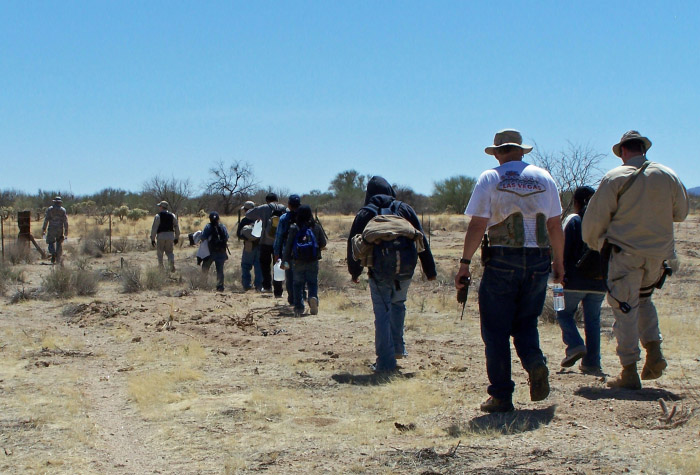
The Minuteman photo gallery raises more questions. For a group that claims to instruct its members not to confront groups of illegal immigrants or to leave their posts, why do we see Minutemen marching a group of immigrants here with no Border Patrol in sight(Perhaps a more disturbing question is why three out of the four Minutemen, who always work in pairs of two or more, in this picture are visibly carrying side-arms, which, according to their regulations, are to be always holstered and used only for self-defense. The math just doesn't quite add up.)? And why do we see a photo of a group of immigrants being sneaked up upon here? Both of these photos seem to violate their third and fourth SOPs. And why do they find this concept along the Canadian border so disturbing?

While the Minutemen claim to be a civil defense project, they are, in reality, vigilantes. They may not be racists, but they are nationalists. In their minds, illegal immigrants aren't human (the word "disgusting" is often used by them to describe Mexican immigrants, illegal or not). This video of a Minuteman march in LA shows the true mentality, depicting the baseless accusations that members of the Minuteman movement make against all immigrants.

While I think immigration should be done legally, taking the law into your own hands is dangerous. Making such accusations as members of the movement do is uncalled for. The Minuteman movement needs to be dissolved to make way for a better end to the immigration debate.

Rock on.

17 May 2007

Another News Round-Up...

The last time I did this, I had the misfortune of reporting the news of the Virginia Tech massacre. I am pleased to say that this time, I don't have anything nearly as gruesome to report on.

In the presidential debate, Giuliani and Edwards both hold stock in companies doing business in Sudan. Both claim they were unaware of the investments, both worth thousands of dollars. While both candidates say they are shocked and will quickly sell the stock, this raises the question of why aren't our politicians looking at where there money is going? And if they don't know what they aren't on top of their own investments, will they show similar care with the nation's finances?

Today was doubly rough for Rudy, who was rejected by James Dobson. Whether or not the founder of Focus on the Family should have a say in who the Republican candidate will be is still up for debate, but for Dobson's many supporters, the former mayor is on his way out. Giuliani, who attempted to defend his stance on abortion at a Baptist college in Texas, is having trouble courting the religious right. Despite leading in some polls, this may cost him the election (the same way it won the election for Reagan and George W).

As far as the religious right is concerned, they are mourning the loss of one of the prominent members, Jerry Falwell, who died yesterday. While I disagree with Mr. Falwell on many issues, I pray for comfort for his family and friends.

In other political news, a bipartisan group of politicians have agreed on an immigration reform plan. Official debate begins on Monday, though many congressman from both sides have criticized it as either too harsh or not harsh enough (generally a good sign that it's a moderate proposal).

In Hollywood today, Paris Hilton (I want to cry for actually putting her in my blog) dropped her appeal for her less than two month prison term. What gets me is the one-liner near the end, "She could have a cellmate." On the other side of the legal spectrum, Lindsay Lohan will not be charged with grand theft after it was ruled that there is not enough evidence to move forward with allegations of her stealing a shirt. I'm sure that somewhere, a preteen girl is excited over this.

Again, I do this to take a look at what our media tells us is important. If I'm reading this correctly, the only things in politics is the presidential election, illegal immigration, and a congressional stalemate over Iraq. Meanwhile, an important preacher died and two of America's royalty are having some legal troubles. Never mind that the presidential election is more than a year away. Never mind that while immigration is an important issue, the country has some other major issues to deal with (whatever happened to the concern over Social Security?). Never mind that the use of war as a means for political gain (on both sides) is disgusting. Never mind that many Republicans have changed their opinions on Mr. Falwell to court his followers. And never mind that the people young Americans care about the most are over-privileged and over-paid and yet under-talented. Never mind that there is actually more in the world than the US, its border with Mexico, and Iraq.

It is said that the media shapes the minds of the people. But it is also said that the people tell the media what to play. So where did this all begin? Which came first, the chicken or the egg? And where will it end? When will we finally decide to wake up and realize that our culture is nothing more than a simulation, a copy, and a poor one of that, of the ancient Romans, with our bread and circuses (bread replaced with fast food and chariots replaced with bad movies), fed to us in thirty second sound bites? And we thought that the Matrix was just a movie...

Rock on.

22 April 2007

Roosevelt Institution at the University of Georgia

Today, I had the privilege to attend the Roosevelt Institution's second annual Roosevelt Policy Symposium. For those who don't know, the Roosevelt Institution is the only policy think-tank for students. Involved students come from all fields of study and are committed to not just being cynical of the world around them, but to actually trying to make a difference. They research and suggest policies for local, regional, national, and international change. Today, three members presented very intriguing proposals on Chinese involvement in Africa (a very enlightening presentation), production and use of cellulosic ethanol at UGA as a model for the rest of the nation, and an especially interesting proposal for modification to federal regulation on stem cell research.


The students presented their proposals to the audience and guest speaker Senator Johnny Isakson (R-GA) offered his critique of ideas put forth. He even took a few questions from the audience (including my question on US involvement with the UN peacekeeping mission in Darfur). The senator also briefly mentioned Iraq and admitted to mistakes being made, though, in keeping with the administration's latest policy, sounded a lot like the Democrats in mentioning redeployment (on a tangent, I'm starting to notice that while the Democrats, for the most part, are calling for quick withdrawl, the Republicans, even the president's cabinet, are starting to mention the idea of pulling out).


All of this is to say that there is still hope. My generation is not entirely lost. Some students are working to make the world a better place. They take it past my own level of cynicism and use their anger about the way things are to work towards the way things should be. There are people out there who care about Sudan and the environment. Maybe students aren't so apathetic after all.


Rock on.